State of the Project, August 2023

Photo by Luis Zheji on Pexels.com

Greetings, gentle readers! The end of Hot Data Summer is upon us, and I have nearly finished all my class prep for the next semester’s teaching. Around and among and before that, I’ve been busily embarking on Phase 2.2 of the project, which as stated in July’s update, involves breaking out the data by library/institution (it depends on the nature of the organization and its libraries — there’s a system, I promise) and verifying holdings via catalog searches and/or contacting the library directly in some cases.

Thus far I’ve completed a mere twenty libraries, but that’s still served to provide some interesting insights. I have eliminated some prospective holdings (either they don’t exist or were online access only), but I’ve uncovered at least as many that simply weren’t in ESTC or Worldcat when I used it, for whatever reason. I knew there would be missed volumes, so that isn’t that surprising, but the number and type of them is still intriguing. As an example, an early data point (we’ll see if it holds) is that out of those 20, six libraries have multiple pre-1850 editions of the Memoirs of the Duke of Sully. What does that mean? I’m not sure, but it’s something to ponder and look into further if it holds up.

As far as the database design goes, I’ve put it aside for the moment. I could, in theory, enter holdings in as I confirm them (almost certainly a good idea, now that I think about it) but I would like to get a bit more done in confirmation first, and then perhaps have phases of entering data as opposed to a more constant back and forth.

Number of libraries confirmed: 20
Number of libraries entered into the database: 2
Number of extant copies confirmed: 77
State of the Project, July 2023

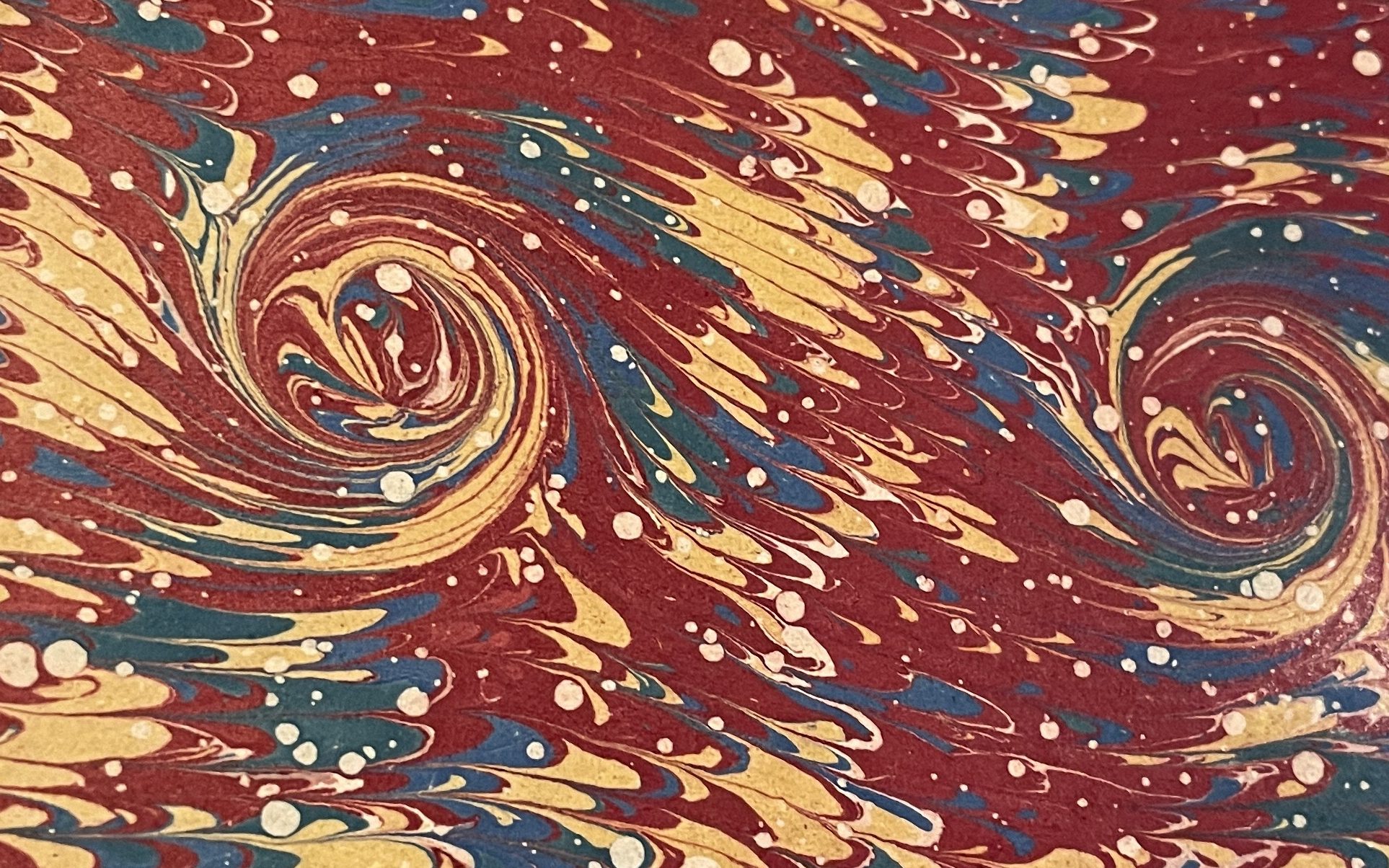
Marbling from the end papers of a fantastic book at the Library Company of Philadelphia

Greetings, gentle readers. I am thrilled to share the news that I’ve finished Phase 2.1! I’ve finally completed* aggregating all the map location data into one huge Excel workbook. Now I can pull it all together into a single worksheet and create some pivot tables to help me cross reference locations. I have also added all the rest of the maps into the Maps page here on the site, for anyone who’s interested in seeing them. Just as a note, the maps are cleared of duplicates, but do not yet represent verified holdings.

The next step is Phase 2.2, wherein I put all the data in a single sheet, create a massive pivot table, and break out the results by library/institution so I can see which institutions have what books and start planning the in-person gathering of bibliographic data, as well as the applications to fund the travel required to visit those collections. I’m not sure how long that portion of the project will take, but I think it should be considerably less than the previous phase if only due to the relative lack of data entry.

I also need, while this process continues, to start finalizing some decisions about the Heurist database I’m using. I’ve started working on importing some data and creating the structure and relations based on the data I have. I’m still very much in the mess-around stage of making the database — there are no permanent decisions in place yet. I’m happy with how things are shaping up, though.

Finally, as a few data points:

  • The last title I put into the workbook was The History of Eliza.
  • Since June’s update, i’ve entered 472 entries across four titles, including the most famous of Lennox’s works, The Female Quixote (which had 309 entries).
  • 2612 records total at the end of Phase 2.1.

*I fully expect to find material that I’ve accidentally left out or overlooked. No process is perfect, after all.

State of the Project, June 2023

A green landscape, looking out from a shady wooded area into a sunlit yard, with a large statement tree off to the right side and a wooden fence in the distance.

The view from the back of my house

Greetings, gentle readers! The summer has almost returned, and I’m managing to make this post mid-month as opposed to nearly-done-month. Overall I’m quite pleased with my industry.

Insofar as the project goes, finishing the semester has done wonders for my ability to keep working on my data. I completed working on the Marquis de Sully finally and was able to likewise finish Old City Manners, Philander, Poems Upon Several Occasions*, and Shakespear Illustrated, the latter just this evening. I’m very happy with the rate of progress I’m making.

In addition to working through the data and cleaning it up, I’m currently trying to work through two different problems. The first thing I’m trying to sort out is regarding periodical reprints of Lennox’s work. I want to catalog not simply the stand-alone volumes of her works, but also the various reprints, both partial and complete, of her work in periodicals of the time. The problem is, how do I track them? Using the Lennox bibliography in Susan Carlile’s book, Charlotte Lennox: An Independent Mind, I have a list of excerpts in various publications.

The question, though is this: 1) is that actually all of them? and 2) (and this is a big one) how do I treat these periodicals within the same project as more traditional codex books? Lennox even had her own periodical, The Lady’s Museum. The same periodical may have (and in some cases does have) multiple samples from her various works across time. How do I record that data so that nothing is lost and yet I’m also not doubling my own effort? It’s not that this is a particularly complicated problem; it’s just that the solution I pick will necessarily inform the shape of the project as it goes, so I’d rather do my best to choose something that won’t cause problems later if I can.

The next issue, mostly unrelated to the above procedural quandary, is how to set up my database so that different records can have the same title without it being a gigantic mess. This is actually the easier one to answer, most likely, as I’m sure I’m not the first person building a relational data structure to have multiple entries with the same name, for example, but different data attached to each one. I’m working on doing some reading and I’ve got some feelers out with some data-oriented DBA people I know, and I’ll likely have an answer to this later this month. Once I do, I can keep working on the structure on my Heurist database and importing the material I’ve currently got in spreadsheets. In the meantime, I’ll keep working on the organization and getting the location data sorted, with the goal of being finished with it and organizing the next phase of the project by the fall, aka library fellowship application season.

Current Data Category: Shakespear Illustrated
# of entries in this category to date: 126
# of entries in the worksheet so far: 2140 and counting

State of the Project, May 2023

red tulips next to a stone against a field of brown mulch

Tulips from my garden before the deer ate them.

Here it is, the middle of May already. Where is the April post, you may ask? Well, the April post sadly went the way of the rest of my month of April, swallowed whole by the end of the semester and grading. I got nothing done on the project to speak of in April, though I did find my way into some interesting discoveries.

At the beginning of April/end of March, I attended the ASECS (American Society for Eighteenth Century Studies) annual conference, this year held in St. Louis. While I was there I went to a fantastic panel (okay, many fantastic panels) but this one in particular discussed a very interesting potential path forward for the Lennox project. This panel included a paper by Norbert Schürer (CSULB), who was discussing a digital humanities project being created using the Heurist platform — a customizable relational database system that was designed for Humanities research. The platform is free to use, hosted by the University of Sydney. It is based in MySQL, which means that it’s easy to export to somewhere else for hosting or other purposes, and it’s going to be simple to transfer to new homes and interfaces down the line. It can also generate a website interface and has mapping and network visualization capabilities.

No one else has, up to date, used the platform for a descriptive bibliography, so a lot of the relationships and information types I need for my project do not yet exist. Before I start putting in extensive book data, however, I want to take the information I do have and create a locational database that takes the map data sets I’ve created and pulls it together for more effective research planning. To that end, I’ve created a test database and been futzing around with it in my spare time, which has not been terribly plentiful over the past month but should ease up considerably over the summer.

I was torn for a time on how to proceed, as it might be less time consuming simply to switch over to inputting data into the database directly. I think I’ve decided, though, to continue putting entries into the spreadsheets for now while I try to figure out the structures I need in Heurist and build something useful. To that end, I’ve started inputting data again and am nearly done with the Marquis de Sully, which is a relief. I’ll keep you posted on how it all goes.

Current Data Category: Memoirs of the Duke de Sully translation
# of entries in this category to date: 953
# of entries in the worksheet so far: 1505 and counting

State of the Project, March 2023

My dog Noodle, basking in a sunbeam with his blanket.

Welcome back! It’s a bit past the middle of March, Spring has officially sprung for what it’s worth, and Noodle is back to enjoying his sunbeams and blanket in the mornings in our household library.

March saw me attending the annual American Society of Eighteenth Century Studies (ASCES) meeting, held this year in St. Louis, Missouri. The conference went really well, all things considered, and I was glad to have the chance to present a bit of my own work and hear about the awesome things others are doing. I attended a fantastic play reading by the Theater and Performance Caucus, went to a lot of great panels, and in particularly the Bibliographical Society of America panel left me with a LOT to think about.

Specifically, I’m reaching the point in my spreadsheet work that I’m thinking about where the work goes from here and what format is next. At that panel, at a talk by Norbert Schürer, I learned about Heurist, an open access relational database setup designed for humanities research, hosted and overseen at the University of Sydney. I’ve started poking at it since ASECS, and I’m both overwhelmed by and excited about the possibilities. I decided to keep bringing info into my spreadsheets for now as I can manipulate it and export it to the database, which will be faster than putting it all in by hand later (I’ll likely have to do a lot of editing of records and making links, but that’s still less work than inputting everything by hand again).

Progress proceeds apace on record data entry. I’m still working on the Marquis de Sully records, but I’m now onto Map 2 (!) and halfway done with it. Onward!

Current Data Category: Memoirs of the Duke de Sully translation
# of entries in this category to date: 720
# of entries in the worksheet so far: 1272 and counting

State of the Project, February 2023

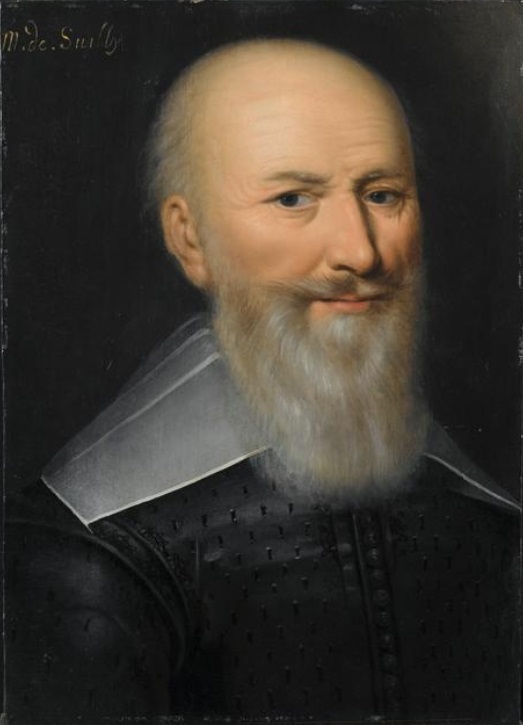
A portrait of Maximilien de Béthune, the Duke of Sully (1559-1641). A balding man with a mustache and a well-kept long beard with a mix of white and light brown hair. He has dark eyes, a keen gaze, and is wearing a starched white collar and black suit like a proper Protestant of his era.
Portrait of Maximilien de Béthune, Duke de Sully
Unidentified painter, Public domain, via Wikimedia Commons

The image I’ve included here is the Duke of Sully, a French Protestant courtier and advisor in the court of Henry IV of France, also known as Henry the Great. You might wonder why I’ve included him here, in the Lennox blog. The answer is that his memoirs (a set of five volumes describing most of his service to Henry IV and that king’s support of Protestantism) were translated into English by Lennox from L’Ecluse’s French edition of Sully’s memoirs (published 1745). Her translation was published in 1751. Lennox’s translation of Sully remained steadily in print for over 100 years after its original debut, making it possibly the most popular of her works (and very nearly the one with the most extant copies — the result remains to be definitively determined.)

I don’t know whether Lennox expected the result of her translation efforts on Sully. Certainly translations of the period didn’t often advertise who the translator was, and neither did the first few editions of Sully. She came to be closely associated with this work, however, and before long was featured as translator on the title pages of the various editions. This alone was not the biggest reason to include Sully in this post, however. I am including him because I feel as though I am chained to him through long familiarity, consisting largely of how long I’ve been working on entering copies of her translation of Sully into my database.

For the record, as of today I am still on map 1 of 3 of extant copies in terms of inputting data, and I’m already at over 300 records with a total of 5 different editions that I’ve worked with so far. I have not yet entered the raw data from The Female Quixote, but I can say that the total number of volumes of Henrietta that I’ve located (pre verification) is only 134. I expect that this will be well over 1000 copies by the time I’m done. It’s in the running to be Lennox’s most popular work, bar none, in terms of the sheer number of editions AND in the number of copies that have been preserved. I’m still so early on in this project that I’m hesitant to form any declarative statements regarding analysis, but what I can saw without fear of contraditions is that there are a whole whacking lot of Lennox’s Sully books out there, and I’m looking forward to seeing more of them in person someday.

Current Data Category: Memoirs of the Duke de Sully translation
# of entries in this category to date: 324
# of entries in the database so far: 876 and counting

State of the Project, January 2023

A snowman with a camera around his neck and an upside red pot on its head for a hat.
Photo by Balu00e1zs Benjamin on Pexels.com

Welcome to 2023! It’s been a busy holiday season — enough so that I didn’t manage to put up a post in December. The spring semester has started, though, and I’ve returned to my data entry. There are an absurd number of entries for the 1856 Bohn edition of The Memoirs of the Duke of Sully, but I’m pushing through. I’ve also had the chance to talk to the head of Special Collections at my institution’s library about increasing our Charlotte Lennox holdings. I’m very excited about the possibilities. Back to work, then!

State of the Project, November 2022

This is a terribly short update, and terribly late as well. November was a very fallow month for the project, with nothing in particular getting done as the day job and the holidays have taken up all my bandwidth. I put off writing this because I was hopeful I would have a better update, but as it is now technically no longer November, I have accepted that this is as good as it gets. Hopefully Christmas break will be more productive again.

State of the Project, October 2022

a bunch of colorful plastic ducks floating in a row down a flowing gutter, facing toward the viewer
Photo by Pixabay on Pexels.com

This month has seen a slowdown in work, in keeping with a rise of effort for the day job. Midterm grading is fast approaching, so I’m trying to stay caught up and yet still keep my hand in here. Also, it’s grant/fellowship application time for next year and I’ve got a job search to attend to, so we’re definitely keeping busy trying not only to keep this year’s ducks in a row, but obtain some ducks for next year as well.

That being said, things proceed apace. I’m at a total of 435 entries in the extant copy database, with two of the most populous and reprinted Lennox works yet to go. Preliminary data from my first special collections trip to Penn State has indicated a couple of interesting things, one of which is that Harrison & Co., publishers of Novelist’s Magazine in the late 1780s, may have simply taken extra copies of the novels reprints for their magazine (or vice versa), stripped off or reprinted the title pages, and bound them up either with other short works that met a given page/signature limit OR with the works that came after them in the magazine sequence, then sold them as standalone volumes. I have not yet been able to make a direct comparison between the bound volumes of the periodical and the novels, regrettably, but I think it’s entirely possible based on the similarities of paper, size, and typeface in their published works. I’m sure once I get past midterms, I’ll have more news. Until then, dear Reader.

State of the Project, September 2022

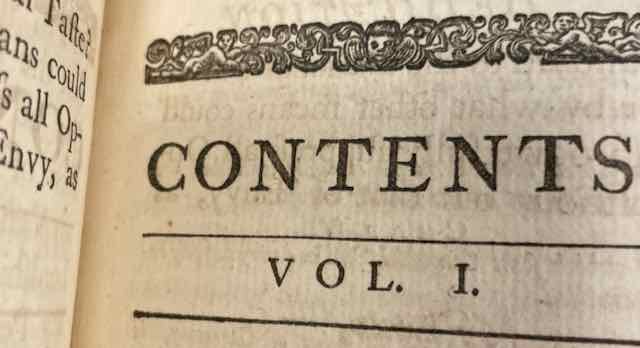
The header of a Contents page from an early edition of The Female Quixote, black print on beige paper.

My apologies for the lateness of this update, as it is very nearly October! I know, however, that my few regular readers will forgive my tardiness. Luckily no one sets their calendar by my updates. 🙂

The month of September is nearly always a month of “festina lente,” as my high school science teacher Mrs. Freese used to say — translated from Latin as either “hasten slowly” or “hurry up and wait,” with the latter being closer to my own experience. The semester starts in earnest, paperwork is in dire need of getting done, the spring semester suddenly has to be settled, and then whoosh, toward the end there’s a chance to breathe again.

I have made some progress this month, hitting that middle space between “not as much as I’d wanted” and “none at all.” I continued entering gathered data into the core spreadsheet, finishing with Henrietta and continuing on through Hermione (possibly misattributed though it may be), The History of the Marquess of Lussan and Isabella, issues of The Lady’s Museum, and The Memoirs for the History of Madame de Maintenon. To this website I’ve added the maps for The Greek Theatre of Father Brumoy and the aforementioned Maintenon title. I am still working on transcribing the data I got at Penn State (and that was a fantastic trip, let me tell you — I finished up with everything I had access to in exactly the time I had to be there, which is something of a minor miracle in itself), but I’ve made great progress on determining what data I’m collecting and what I’m not as interested in. I hope by the end of the year to offer up a sample of that from one of the books I studied.

Next month will probably be slower than this one in terms of overall progress — midterms are never very forgiving of time spent away from grading, and that’s especially true for the classes I’m teaching this semester. That being said, I’m pushing forward as much as I can. I need to get the entries squared away so I can start looking at other fellowship applications for libraries. Now that’s exciting. 🙂