My apologies for the lateness of this update, as it is very nearly October! I know, however, that my few regular readers will forgive my tardiness. Luckily no one sets their calendar by my updates. 🙂
The month of September is nearly always a month of “festina lente,” as my high school science teacher Mrs. Freese used to say — translated from Latin as either “hasten slowly” or “hurry up and wait,” with the latter being closer to my own experience. The semester starts in earnest, paperwork is in dire need of getting done, the spring semester suddenly has to be settled, and then whoosh, toward the end there’s a chance to breathe again.
I have made some progress this month, hitting that middle space between “not as much as I’d wanted” and “none at all.” I continued entering gathered data into the core spreadsheet, finishing with Henrietta and continuing on through Hermione (possibly misattributed though it may be), The History of the Marquess of Lussan and Isabella, issues of The Lady’s Museum, and The Memoirs for the History of Madame de Maintenon. To this website I’ve added the maps for The Greek Theatre of Father Brumoy and the aforementioned Maintenon title. I am still working on transcribing the data I got at Penn State (and that was a fantastic trip, let me tell you — I finished up with everything I had access to in exactly the time I had to be there, which is something of a minor miracle in itself), but I’ve made great progress on determining what data I’m collecting and what I’m not as interested in. I hope by the end of the year to offer up a sample of that from one of the books I studied.
Next month will probably be slower than this one in terms of overall progress — midterms are never very forgiving of time spent away from grading, and that’s especially true for the classes I’m teaching this semester. That being said, I’m pushing forward as much as I can. I need to get the entries squared away so I can start looking at other fellowship applications for libraries. Now that’s exciting. 🙂
First of all, I am so very pleased to announce that I’ve received the 2022-2023 Helen F. Faust Women’s Writers Research Award from the Penn State Special Collections library. I’ll be traveling to the Eberly Family Special Collections Library next week to dig into their Charlotte Lennox holdings, starting the archival research in earnest. All my deepest thanks to the Penn State Libraries for helping fund this travel and research, and I can’t wait to see what we find!
The amusing part of all this, of course, is that — proceeding in an orderly planned fashion — I assumed next summer would be the beginning of my archival research, and I had tons of time to plan out the scope and types of data and do some trial runs on local holdings. And thus, to paraphrase the poets, does fate make fools of us all. I’m therefore doing all my data planning this week, then, and figuring out how I’m going to record it, what I want to take note of, where I want to store it, and how I’m going to eventually put it all together, as least to the extent that I can without having done it (which means it’ll absolutely change between now and later).
I’m recording the trials and tribulations of the project, by the way, not because I particularly feel they’re worthy of recording for the sake of the project, but because I want people who take on similar projects to be able to look back at this and know they aren’t alone. I believe very strongly in breaking out of the strictures of “professionalism” and the gatekeeping they enact. To be “professional” too often means to speak only of your successes, downplay your failures or challenges, and deny weakness or missteps. The parts we edit out, though, in order to achieve that seamless appearance, are where the opportunities for growth and the useful case studies for others happen to be. I’m under no illusion that this blog will be a source of fascinating reading material for a huge audience, but my hope is that for those who need it or like it, it will serve to light their own path a little, if only dimly.
Back to business. I’ve finished importing The Life of Harriot Stuart and I’ve been working on Henrietta for a while now — see previous posts about the better selling books taking far longer. I’ve also added the Henrietta maps to the website. As a note, this process of importing might take longer than one would ostensibly wish, but it’s already helped me locate some discrepancies and repeated data points, which I am correcting in the maps as well when I find them. I’ve also discovered, for anyone playing along at home, that my KMZ-to-CSV converter does not know what to do with a layer in Google Maps that has symbols in it, like ” or , or so forth. It therefore simply does not extract that layer, which means I have to go in and enter it by hand (which fortunately I can do, having the maps to hand). Things to know for the future, I suppose.
Next up: Finish Henrietta, move on to the next item on the list, travel, do archival stuff, take lots of notes and images, start creating the archive!
So, dear Readers, work proceeds apace — and, in fact, at a faster clip than I’d anticipated, which is very heartening. I’ve exported the map data and converted the files into CSVs from KMZ format, and now I’m adding the information into one big Excel workbook. After a little experimentation, I’ve decided that each title gets its own sheet within the larger workbook. I then import each layer from the map individually, as I had the conversion program break it out that way — better granularity makes for more work but also makes it easier to trace back and verify data in one place rather than repeatedly.
As far as the data goes, I’ve also been adding library affiliations and categorizations. One thing that’s been interesting to me is that although I haven’t found any libraries that focus on Lennox in their collections per se, I have found her works — particularly her translations — in a very wide variety of institutions, particularly in the US. By categorizing the types of institution, I’m establishing another set of data points that may point me toward provenance, or at least give me some interesting information to go on.
As of right now, I’ve finished importing the Countess of Berci, The Count of Comminge, Euphemia, and the Greek Theatre of Father Brumoy. I’m halfway done with The Life of Harriot Stuart. The thing about these listings is that they’re all relatively short. The big ones (I’m looking at you, Marquis of Sully) are going to take considerably more time. I’m going to be very interested to see where I can get to by this time next month, though.
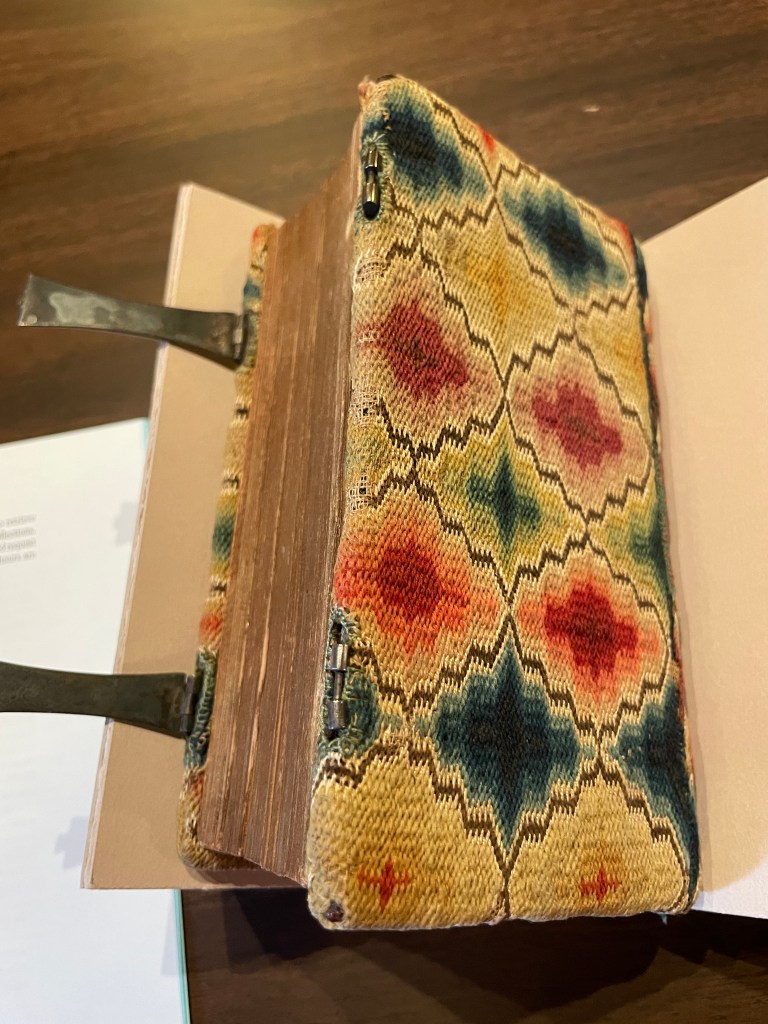
Oh, dear Readers, it has been an incredibly busy month. First of all, let me direct your attention to the picture on the right, which was only one of the amazing books I got to squee over and learn from at the RBS session on The History of the Book in America, 1700-1830, held at the Library Company of Philadelphia and taught by the excellent scholar James Green, who is Librarian Emeritus at that institution.
During that week, I learned very little about Lennox directly, but a ton about printing in the early United States and how her books likely came to be in the US. It opened so many avenues in my future research that I had not even considered, and I’m absolutely thrilled that I went. I should state that I was pleased to attend via a William T. Buice Scholarship, courtesy of UVa’s Rare Books School. I encourage anyone who’s interested, particularly NTT or independent scholars, to apply and help defray the tuition and fees involved with attending.
Aside from the RBS course, I’m incredibly excited to share that I’ve completed Phase 1.1 of the LBP! Phase 1.1 refers to the gathering of raw location data of extant copies of Lennox’s published work, recorded through Google maps and added to the Maps page on this site. The data now gets downloaded and converted to a .csv format, and then aggregated so I can check individual libraries for their actual holdings and eliminate any digital access copies that snuck in, or add material that got missed.
Once I’ve cleaned up and verified the data, then I’ll move on to analysis and remapping. At the same time, I’ll take on Phase 2, which is determining the data types I’m collecting and what I want the overall schema of the project to be. This section includes longevity planning, scalability, UI design and parameters, and a potential push for a sharable bibliographic interface that can be tweaked for use in other projects free of charge. I don’t anticipate starting Phase 2 before 2023, and I likely won’t be doing any serious data gathering on the books themselves until nearly 2024, though I’d be happy to be overestimating the timeline here.
All in all, I’m very excited about progress this summer and what next month brings. Stay tuned!
Mary Sandwith’s Bible, from 1743. She embroidered this cover as a girl — the date she stitched on the spine is from when she was 11 years old. Part of the Library Company of Philadelphia’s collections.
As I was browsing my way through the Penn State library website to determine what they had there that I’d need to use, I ran across an electronic copy of the work whose title page is featured here: Angelica; or Quixote in Petticoats, a Comedy in Two Acts. This 1758 play was not written by Charlotte Lennox, though there’s a note at the end of the dedication noting that they took Angelica (originally Arabella) and most of the plot wholesale from The Female Quixote by “Mrs. Lenox.” Nice to give credit for that much, at least, and it speaks to the contemporary popularity of the novel that it inspired this knock-off play.
Since the April update, the month has been extremely hectic. The end of the semester hit along with all the deadlines for grading and teaching, I caught a cold that turned into bronchitis (but was not covid), and my father passed away — all of which left the project lying somewhat fallow. That being said, I did get some additional progress made.
Current Status: In addition to the completed data from April, I have completed the information for Henrietta and Old City Manners, and begun working on Lennox’s play The Sister, which is based on her novel Henrietta and has led to a couple of confusing entries as a result. I’ve gotten them sorted, but it took slightly longer than I’d wanted. I’ve also added a Maps page with links to the Google maps I’ve created to plot out locations of extant copies of Lennox’s work. I’ve only got two works up so far (more evidence of my busy month) but I will have more this month. The information in those maps will be distilled out and converted into spreadsheets, but I’ve got more verification and data clean-up to do before that will be useful.
In addition, I’ll be attending a session of the University of Virginia’s Rare Book School in June, likely prior to the next update, focusing on the early history of printing in America to help me suss out what’s going on with Lennox’s early American reprints. I’ll be spending a week at the Library Company in Philadelphia and I cannot wait. It should be greatly enlightening, not to mention the fact that the Library Company has a number of hard-to-find works of Lennox’s and is on my list of locations to revisit at a later date.
Overall, I expect to make a nice bit of progress this month, so check back for more changes as we go.
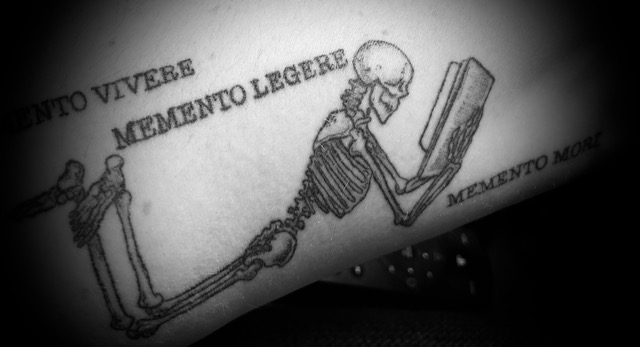
The tattoo’s Latin text reads, “Remember to live, remember to read, remember you will die.”
In his Principles of Bibliographical Description, Fredson Bowers talks about how every bibliography has to have a unifying purpose in order to be something more than just a list of minutiae — or to borrow a phrase he borrowed, a “spire of meaning.” That sounds very elevated, very idyllic, to have a spire of meaning for your project. I have a hard time picturing Bowers as being fanciful, but his obvious attraction to the term “spire of meaning” goes a long way toward making that argument.
To the point, though, Bowers’ statement that a descriptive bibliography in particular cannot be simply a collection of raw facts about material books has a point. Like every fact or list thereof, a descriptive bibliography requires context and cohesion in order to make the data mean something. A collection without a theme is just material noise; it’s the order and context that give it meaning and transform it into a signal worth hearing. The same thing holds true for this project.
Now, while the foundational unifying principle for the Lennox Bibliography Project is in the name — a descriptive bibliography of the works of Charlotte Lennox, 1747-1850 — that’s more of a descriptor than a mission statement. All communication is edited; a perfect and complete transmission of knowledge is impossible, particularly in such a long-term effort at information gathering and presentation as this one. While it is currently a solo effort, it’s entirely possible that there will be collaborators down the line. It is crucial, therefore, to lay out not only the raison d’etre for the project, but also the rationales that guide our choices and determine how priorities are set and acted upon. Some of these are clear (and will be discussed in time); some are more challenging, and I have to define them as I go. One of the latter is the concept of feminist bibliography and how it relates to this project.
I am by no means the first scholar down this path. Sarah Werner is a leading voice in this field and has done a considerable amount of work, including some fantastic recorded talks, such as this one.
Kate Ozment’s article “Rationale for Feminist Bibliography” (Textual Criticism 13.1 2020) is pretty much required reading for why this approach matters and what forms it might take in application. It’s also open access and well worth your time, so if you haven’t looked at it, you should.
Margaret JM Ezell, Tia Blassingame, Lisa Maruca, Megan Peiser… all of these powerful scholars have engaged and are engaging with what it means to take feminism into a discipline so foundationally gendered as bibliography can be. It is only to be expected, then, that in a project like this one — focusing on a woman author, written by a woman scholar, with the hope of inspiring and facilitating the work of others in this vein — would have to come to terms with not only what a feminist approach entails, but what its ramifications are as a guiding principle. To take a page from others, then, I will lay out the following precepts.
Feminism for this project is defined as:
Intersectional — it functions on the principle of inclusion, not exclusion. It is not exclusive to race, class, or gender identity.
Transparent — by documenting this journey, its progress, and how decisions were made, it can serve as something between inspiration/object lesson for those who might be interested in doing something similar.
Accessible — This bibliography will always be available to the public at large, at least if I have anything to say about it. There will be no charge to use it. It is an open resource.
Political — choosing to carve a new path is inherently an act of resistance. The systems that led to an unbalanced representation and focus within bibliographical studies (among other things) are still there; it’s our participation and examination of how we got here and what really happens that makes change happen and keeps the discipline vital.
Feminist bibliography in praxis for the Lennox Bibliography Project is a work in progress, but here’s some building blocks to work with based on the above statements.
The Lennox herself: It’s focused on Charlotte Lennox, who was a working woman writer who needed to support her husband, children, and herself.
Bibliographical work is not — cannot — be limited to only “original” works. Lennox wrote plays based on existing material and translated numerous works. She collaborated and cultivated professional relationships of mutual benefit. A feminist bibliography cannot ignore all the nonstandard (but very common) types of work she did simply because she was not the sole original author of the material.
Provenance is key, as is looking for copies in unexpected places and tracking how the copies came to be where they are. This is beyond the scope of most bibliographies and is something I’m still trying to figure out, but I feel like it’s an important piece of the puzzle and I want to find a way to include the data where I can.
Open access and shared data sets. I want to make what I find available for others to use and replicate. I would dearly love to get an interface together that others could use with their data, but that’s almost an entire second project. We’ll see. I’ve got time.
Elevating voices. I want to stay connected with others doing work in DH and who are working on women and people of color.
Time will tell if this is going to work or not, and how all of this gets implemented. But it’s better to think about it from the beginning than retrofit things as we go, inasmuch as that’s a possibility. As always, I welcome thoughts and input on anything I may have overlooked.
One of the reasons I started the blog was to give updates on progress and share discoveries as they come up, as well as offer transparency into what the process is of making a descriptive bibliography. In order to make that work, of course, it would help to show where we’re starting and what I’m working on at the moment. I’ll be putting up another post later to talk about how I’m doing the work, but for now, I’ll stick to in media res and get more into process later.
Current Status: As of this week, I have the completed the following:
Finished preliminary data gathering* for 11 titles, including:
Poems Upon Several Occasions
The Life of Harriot Stuart
The Female Quixote
Memoirs of the Duke of Sully
Memoirs for the History of Madame de Maintenon
The Greek Theatre of Father Brumoy
Memoirs of the Countess of Berci
History of the Count de Comminge
Philander
Shakespear Illustrated
Euphemia
Started collecting data on Henrietta
Converted data from two of these titles into a combined spreadsheet for test purposes
Worked on learning how to use pivot tables to get interesting data
Created a test data set to start playing with Tableau to see about data visualizations, particularly those involving generating maps
*Publication of excerpts in periodicals remains a tricky point, as those are hard to track down.
Upcoming Tasks: Keep working on preliminary data, start verifying entries on library web sites, keep working on Excel and Tableau skills
Challenges: Periodical info, as mentioned above. Keep working on fleshing out this website with info and links. Manage to keep moving forward while I finish the semester and the grading.
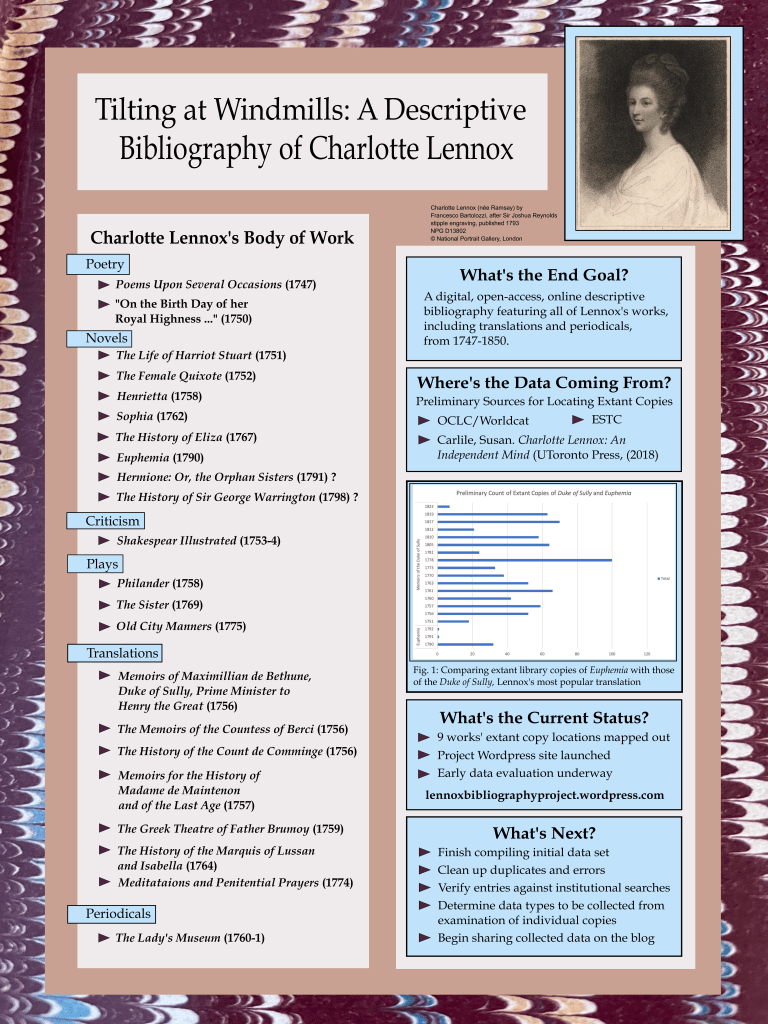
As previously mentioned, I had the opportunity to talk about the project in a session at the American Society for Eighteenth Century Studies (ASECS) annual conference this past week. The panel was hosted by the Digital Humanities caucus, one of two back-to-back sessions titled “Centering Marginalized Voices in Digital Humanities Projects.” There were so many amazing projects discussed, and I was honored to be a part of it. The image to the right is the poster I presented, which I’m sharing here as well. You can also download this poster at the link below if you’re interested in getting a better look at it.
Among the many great projects discussed in that session, I’d like to give a shout out in particular to The Lady’s Museum Project, which is a digital version of Lennox’s periodical The Lady’s Museum. The editors behind this collaborative project to create the first ever critical edition of TLM are Karenza Sutton-Bennet and Kelly Plante, both of whom are brilliant, passionate scholars. I urge you to go take a look at their fantastic work.
Poster presented at ASECS 2022 giving a project overview
I’ll be attending the American Society for Eighteenth-Century Studies annual conference, March 31-April 2 in Baltimore, MD. I’m very happy to be presenting on Saturday, April 2 at 2:00 pm. I’ll be talking about the project in the session, “Centering Marginalized Voices in DH Projects — Workshop.” I will be talking about my goals with this research as well as some of the grey areas and potential challenges involved, with the goal of perhaps getting a bit more clarity and direction on those points. I’ll also have a poster that I’ll be presenting as well for reference, which I’ll make available on this site following the conference. I hope to see you there!



 Lennox Bibliography Project