State of the Project, October 2025

Greetings! This particular post is brought to you by the letter K (and about half of letter L). October is upon us –I’m already mad that the time change back to Standard time isn’t happening until the first week of November, as I can feel that it should be happening about now and it would be the least jarring for it to do so, but no, we have to wait until the first weekend in November because politics and candy lobbyists. Really, it just feels like adding insult to injury this year. There is too much argh happening, and the little bits I can do are not enough to fix any of it. If you feel similarly, you are not alone — keep at those little bits, though. Every tiny pebble helps build the mountain we need, no matter how small.

That being said, bibliography is comparatively a land of calm and sanity, unfazed by the cursed actions of tyrants and an impending lack of vitamin D. To our research we turn, therefore, as a welcome form of respite away from social media and the outside world. (Yes, my prose has gotten rather purple, but for this month at least we’re just going to work with it.) So, on to this month’s overview!

Things I learned from K:

  • To no one’s great surprise, I’m sure, I will be spending a decent amount of time at both the Kislak Library at University of Pennsylvania and Kresge Library at Oakland University. The latter in particular has copies of Lennox’s first book, Poems on Several Occasions (pretty hard to find), and Memoirs for the History of Madame de Maintenon, which is also fairly rare. Excited about both of those.
  • Not that many libraries that start with K, so the letter was shorter than I’d realized. I’d initially thought I might get through both K and L this month, but I forgot about midterm grading and so that plan did not come to pass. No big deal, though.

I have about 75 entries left in L, including the big one at the Library of Congress. Shouldn’t be a problem to get it done for the next update. We shall see! Also, I’ve started entering libraries into my database more intentionally. I may not know exactly what I’m doing with the books yet, but the locations I can build out now.

Number of libraries confirmed: 307
Number of libraries entered into the database: 58
Number of extant copies confirmed: 1156

State of the Project, September 2025

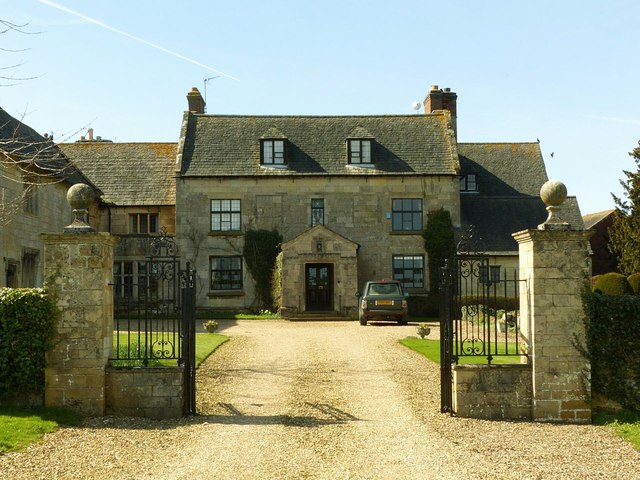
A color photograph of old eighteenth century British manor house, Ingarsby Old Hall. The camera is outside the gate in the driveway, facing the front door. The house is pale beige/dirty white stone/brick, three stories high and symetrical in the main house, with a wing off to the left. It is well kept and there is a small green car parked in front, facing the house.
Ingarsby Old Hall, The 18th century house by Alan Murray-Rust is licensed under CC-BY-SA 2.0

Greetings, gentle reader! Just as GBBO returns with a new season in the USA, so do I return this month with an update on the Lennox Bibliography Project. The world may be a searing hellscape with death, destruction, groypers, assassinations, the death of health insurance and job security in academia, but at least we’ve got a banging recipe for hobnobs I cannot wait to try. I went retro and made old-school, crossed-with-fork-marks peanut butter cookies this weekend, and I do not regret it in the least. That is not why you’re here, though. You’re here for an update! This baking celebration bit is brought to you in honor of the fact that I did, in fact, finish both I and J this past month! To the virtual bibliography tent!

Things I learned from I and J:

  • It was incredibly rude for John D. Rockefeller, Jr. to endow two libraries but name them both after himself.
  • The John Rylands Library at the University of Manchester has a surprisingly robust Lennox collection, much more so than I’d been led to believe by my earlier WorldCat searches.
  • The aforementioned strategy of combining multiple libraries at a single institution when I do the searches has turned out to be a much better strategy. Yay for process iteration!

Seriously, I feel as though I’ve hit a milestone, even though we are not halfway through the alphabet yet. In truth, I felt it so strongly that I did some checking. It turns out that while I may only be on the 10th letter, I’m very nearly halfway through the entries I have in the spreadsheet. I have just under 3100 lines in the sheet with info, and I’ve hit just over line 1550.

Now, there are some caveats to bit of data trivia — first, I’ve been adding blank lines between libraries to help block the data into groups and make it visually easier to track; second, not everything in the file exists, and some are in duplicates but I can’t know that until I track it down and verify it; and third, my newfound method of grouping multiple libraries at an institution means I’ve moved things around slightly as I get to a new place/encounter a place I’ve started before. I don’t really think this last point is statistically significant, but it does mean it takes me slightly longer to quantify my progress when I sit down to it.

Database Musings

In addition, now that I’ve hit something approximating midpoint, I felt my attention turning back to the Heurist database. It’s gone through some updates and improvements, and I’m very pleased with it overall. Still easy to use and enter data, but with new, easier to parse mapping capability, which is one of the things I very much wanted (and why I kept the library coordinates from Google Maps, so I could eventually see proximity data and plan out trips. Also because I think it’s cool). I also realized I was a little offbase about the number of entries I was quoting. I have two books and their locations in the database, not two libraries. I have 54 library entries thus far, with two new ones as of today.

That, of course, is not as simple as adding two records. For those of you familiar with relational database work, you probably know more than I do and can skip this part. For everyone else, in order to make this work, you can think of it as putting a bunch of different pegs on a pegboard, each for a different data point, and then using yarn to connect them. So for every book location, I need not only the info about the book, but about the library it’s in. For every library, I need the institution it’s connected to. Each library entry is therefore at least two entries, along with all the connections to be made and the mappable location entered. I’ve put off entering in more books until I get the library locations entered, at least as far as today’s plan goes. I may change my mind and start entering books again just to get the basic info in place and connections made.

Beyond that, I still need to decide exactly how I’m going to put information about the books — collation formulae, images, provenance, marginalia, as well as the standard bibliographic stuff. For most of Lennox’s work, this is not hugely problematic in terms of parsing out issue, edition, etc., at least not on the face of it. Most of her works didn’t go through too many printings/editions, and the ones that did often were either international, translations, or clearly post-1774/Donaldson v. Beckett reprints from different publishers, so the status of the edition is pretty clear. 1

Regardless, all of that has to be determined eventually. I know I’m heavily interested in individual issues and evidence of use of Lennox’s books, but I don’t want to shortchange the more traditional bibliographic data either. I also frankly need a refresher on determining all of it, because it’s been a hot minute since RBS and I’ve been busy doing other, more day job-related things. I’ll sort it out as I get closer, though. This is a marathon, not a sprint.

  1. This assessment does not, FYI, include the many and varied printings/editions/issues/whatever of the Memoirs of the Duke of Sully in its varied titles and incarnations. ↩︎

Number of libraries confirmed: 281
Number of libraries entered into the database: 54
Number of extant copies confirmed: 1038

State of the Project, July 2023

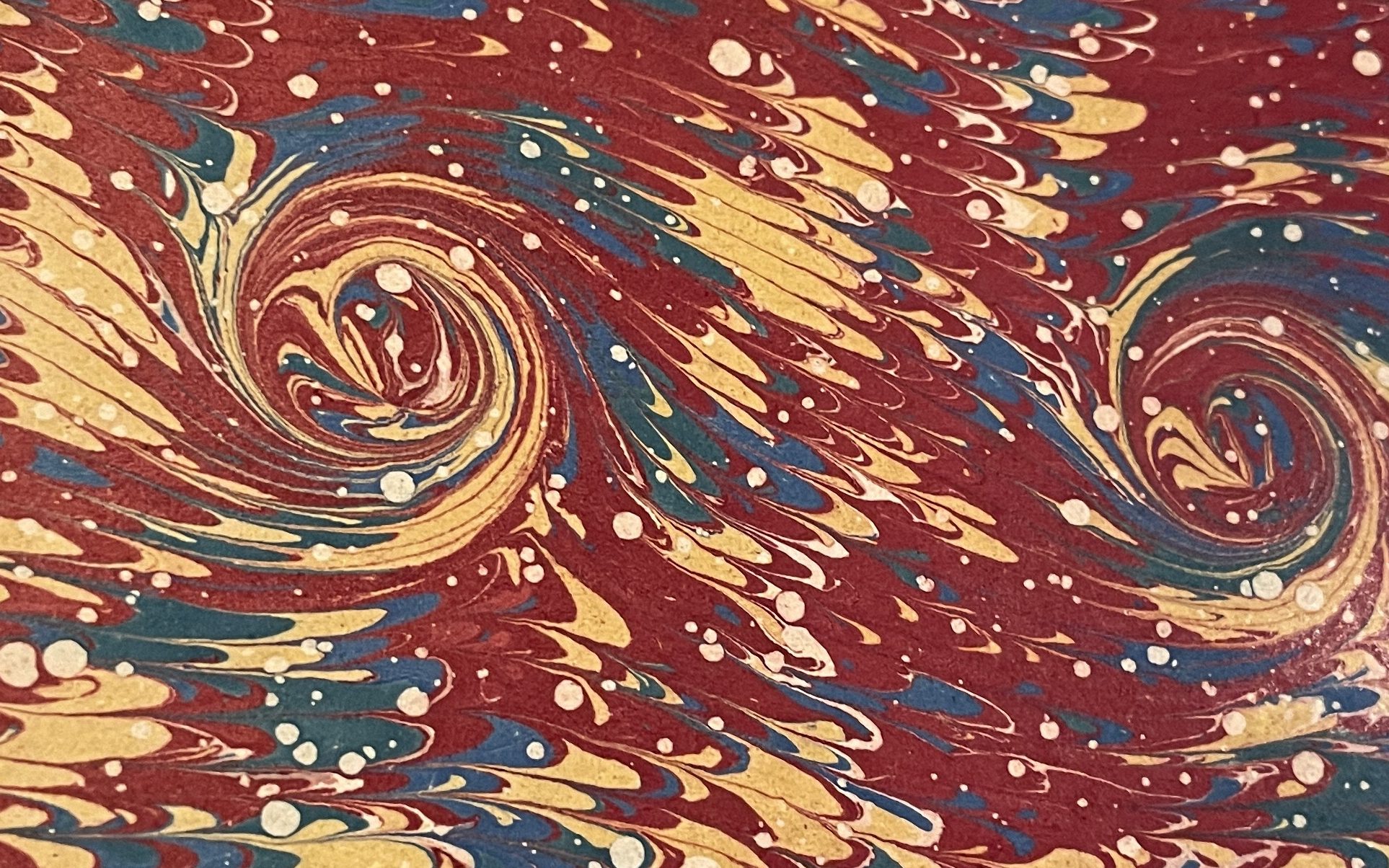
Marbling from the end papers of a fantastic book at the Library Company of Philadelphia

Greetings, gentle readers. I am thrilled to share the news that I’ve finished Phase 2.1! I’ve finally completed* aggregating all the map location data into one huge Excel workbook. Now I can pull it all together into a single worksheet and create some pivot tables to help me cross reference locations. I have also added all the rest of the maps into the Maps page here on the site, for anyone who’s interested in seeing them. Just as a note, the maps are cleared of duplicates, but do not yet represent verified holdings.

The next step is Phase 2.2, wherein I put all the data in a single sheet, create a massive pivot table, and break out the results by library/institution so I can see which institutions have what books and start planning the in-person gathering of bibliographic data, as well as the applications to fund the travel required to visit those collections. I’m not sure how long that portion of the project will take, but I think it should be considerably less than the previous phase if only due to the relative lack of data entry.

I also need, while this process continues, to start finalizing some decisions about the Heurist database I’m using. I’ve started working on importing some data and creating the structure and relations based on the data I have. I’m still very much in the mess-around stage of making the database — there are no permanent decisions in place yet. I’m happy with how things are shaping up, though.

Finally, as a few data points:

  • The last title I put into the workbook was The History of Eliza.
  • Since June’s update, i’ve entered 472 entries across four titles, including the most famous of Lennox’s works, The Female Quixote (which had 309 entries).
  • 2612 records total at the end of Phase 2.1.

*I fully expect to find material that I’ve accidentally left out or overlooked. No process is perfect, after all.

State of the Project, June 2023

A green landscape, looking out from a shady wooded area into a sunlit yard, with a large statement tree off to the right side and a wooden fence in the distance.

The view from the back of my house

Greetings, gentle readers! The summer has almost returned, and I’m managing to make this post mid-month as opposed to nearly-done-month. Overall I’m quite pleased with my industry.

Insofar as the project goes, finishing the semester has done wonders for my ability to keep working on my data. I completed working on the Marquis de Sully finally and was able to likewise finish Old City Manners, Philander, Poems Upon Several Occasions*, and Shakespear Illustrated, the latter just this evening. I’m very happy with the rate of progress I’m making.

In addition to working through the data and cleaning it up, I’m currently trying to work through two different problems. The first thing I’m trying to sort out is regarding periodical reprints of Lennox’s work. I want to catalog not simply the stand-alone volumes of her works, but also the various reprints, both partial and complete, of her work in periodicals of the time. The problem is, how do I track them? Using the Lennox bibliography in Susan Carlile’s book, Charlotte Lennox: An Independent Mind, I have a list of excerpts in various publications.

The question, though is this: 1) is that actually all of them? and 2) (and this is a big one) how do I treat these periodicals within the same project as more traditional codex books? Lennox even had her own periodical, The Lady’s Museum. The same periodical may have (and in some cases does have) multiple samples from her various works across time. How do I record that data so that nothing is lost and yet I’m also not doubling my own effort? It’s not that this is a particularly complicated problem; it’s just that the solution I pick will necessarily inform the shape of the project as it goes, so I’d rather do my best to choose something that won’t cause problems later if I can.

The next issue, mostly unrelated to the above procedural quandary, is how to set up my database so that different records can have the same title without it being a gigantic mess. This is actually the easier one to answer, most likely, as I’m sure I’m not the first person building a relational data structure to have multiple entries with the same name, for example, but different data attached to each one. I’m working on doing some reading and I’ve got some feelers out with some data-oriented DBA people I know, and I’ll likely have an answer to this later this month. Once I do, I can keep working on the structure on my Heurist database and importing the material I’ve currently got in spreadsheets. In the meantime, I’ll keep working on the organization and getting the location data sorted, with the goal of being finished with it and organizing the next phase of the project by the fall, aka library fellowship application season.

Current Data Category: Shakespear Illustrated
# of entries in this category to date: 126
# of entries in the worksheet so far: 2140 and counting

State of the Project, March 2023

My dog Noodle, basking in a sunbeam with his blanket.

Welcome back! It’s a bit past the middle of March, Spring has officially sprung for what it’s worth, and Noodle is back to enjoying his sunbeams and blanket in the mornings in our household library.

March saw me attending the annual American Society of Eighteenth Century Studies (ASCES) meeting, held this year in St. Louis, Missouri. The conference went really well, all things considered, and I was glad to have the chance to present a bit of my own work and hear about the awesome things others are doing. I attended a fantastic play reading by the Theater and Performance Caucus, went to a lot of great panels, and in particularly the Bibliographical Society of America panel left me with a LOT to think about.

Specifically, I’m reaching the point in my spreadsheet work that I’m thinking about where the work goes from here and what format is next. At that panel, at a talk by Norbert Schürer, I learned about Heurist, an open access relational database setup designed for humanities research, hosted and overseen at the University of Sydney. I’ve started poking at it since ASECS, and I’m both overwhelmed by and excited about the possibilities. I decided to keep bringing info into my spreadsheets for now as I can manipulate it and export it to the database, which will be faster than putting it all in by hand later (I’ll likely have to do a lot of editing of records and making links, but that’s still less work than inputting everything by hand again).

Progress proceeds apace on record data entry. I’m still working on the Marquis de Sully records, but I’m now onto Map 2 (!) and halfway done with it. Onward!

Current Data Category: Memoirs of the Duke de Sully translation
# of entries in this category to date: 720
# of entries in the worksheet so far: 1272 and counting