State of the Project, October 2022

a bunch of colorful plastic ducks floating in a row down a flowing gutter, facing toward the viewer
Photo by Pixabay on Pexels.com

This month has seen a slowdown in work, in keeping with a rise of effort for the day job. Midterm grading is fast approaching, so I’m trying to stay caught up and yet still keep my hand in here. Also, it’s grant/fellowship application time for next year and I’ve got a job search to attend to, so we’re definitely keeping busy trying not only to keep this year’s ducks in a row, but obtain some ducks for next year as well.

That being said, things proceed apace. I’m at a total of 435 entries in the extant copy database, with two of the most populous and reprinted Lennox works yet to go. Preliminary data from my first special collections trip to Penn State has indicated a couple of interesting things, one of which is that Harrison & Co., publishers of Novelist’s Magazine in the late 1780s, may have simply taken extra copies of the novels reprints for their magazine (or vice versa), stripped off or reprinted the title pages, and bound them up either with other short works that met a given page/signature limit OR with the works that came after them in the magazine sequence, then sold them as standalone volumes. I have not yet been able to make a direct comparison between the bound volumes of the periodical and the novels, regrettably, but I think it’s entirely possible based on the similarities of paper, size, and typeface in their published works. I’m sure once I get past midterms, I’ll have more news. Until then, dear Reader.

State of the Project, June 2022

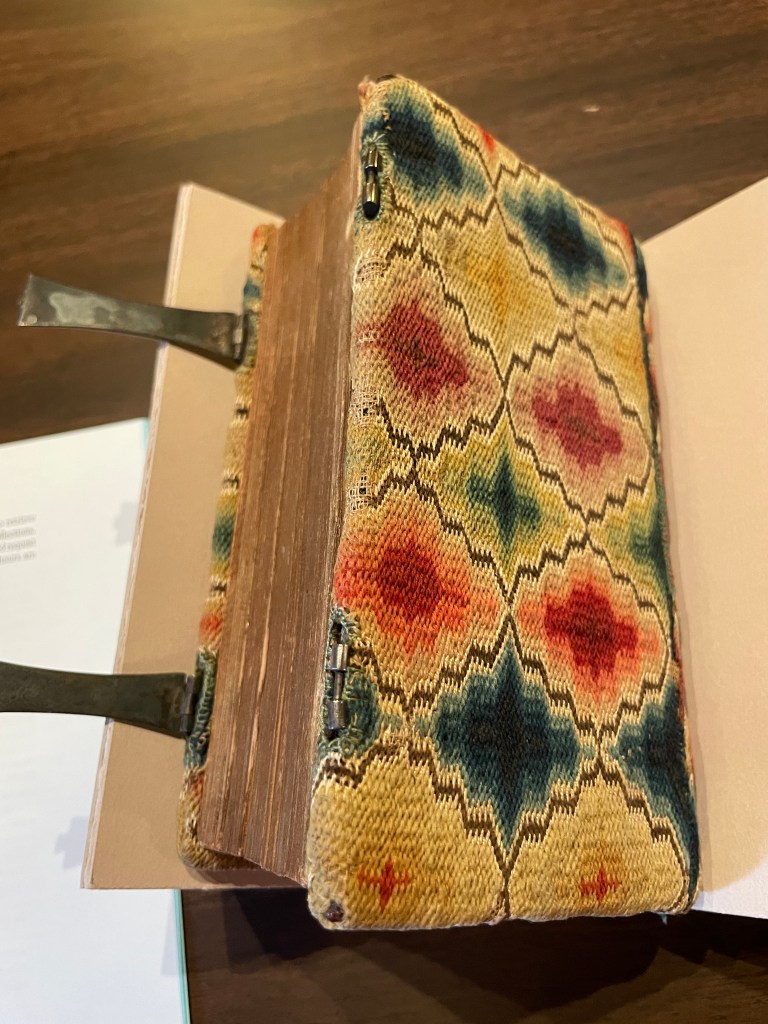
Oh, dear Readers, it has been an incredibly busy month. First of all, let me direct your attention to the picture on the right, which was only one of the amazing books I got to squee over and learn from at the RBS session on The History of the Book in America, 1700-1830, held at the Library Company of Philadelphia and taught by the excellent scholar James Green, who is Librarian Emeritus at that institution.

During that week, I learned very little about Lennox directly, but a ton about printing in the early United States and how her books likely came to be in the US. It opened so many avenues in my future research that I had not even considered, and I’m absolutely thrilled that I went. I should state that I was pleased to attend via a William T. Buice Scholarship, courtesy of UVa’s Rare Books School. I encourage anyone who’s interested, particularly NTT or independent scholars, to apply and help defray the tuition and fees involved with attending.

Aside from the RBS course, I’m incredibly excited to share that I’ve completed Phase 1.1 of the LBP! Phase 1.1 refers to the gathering of raw location data of extant copies of Lennox’s published work, recorded through Google maps and added to the Maps page on this site. The data now gets downloaded and converted to a .csv format, and then aggregated so I can check individual libraries for their actual holdings and eliminate any digital access copies that snuck in, or add material that got missed.

Once I’ve cleaned up and verified the data, then I’ll move on to analysis and remapping. At the same time, I’ll take on Phase 2, which is determining the data types I’m collecting and what I want the overall schema of the project to be. This section includes longevity planning, scalability, UI design and parameters, and a potential push for a sharable bibliographic interface that can be tweaked for use in other projects free of charge. I don’t anticipate starting Phase 2 before 2023, and I likely won’t be doing any serious data gathering on the books themselves until nearly 2024, though I’d be happy to be overestimating the timeline here.

All in all, I’m very excited about progress this summer and what next month brings. Stay tuned!

A hand-embroidered cover on a Bible dated to 1743, belonging to Mary Sandwith. It's red, green, blue, and yellow on a cream background using flamestitch.
Mary Sandwith’s Bible, from 1743. She embroidered this cover as a girl — the date she stitched on the spine is from when she was 11 years old. Part of the Library Company of Philadelphia’s collections.

Cool Discovery of the Day, Issue #1

Title page of a 1758 book titled "Angellica: a Comedy in Two Acts".

As I was browsing my way through the Penn State library website to determine what they had there that I’d need to use, I ran across an electronic copy of the work whose title page is featured here: Angelica; or Quixote in Petticoats, a Comedy in Two Acts. This 1758 play was not written by Charlotte Lennox, though there’s a note at the end of the dedication noting that they took Angelica (originally Arabella) and most of the plot wholesale from The Female Quixote by “Mrs. Lenox.” Nice to give credit for that much, at least, and it speaks to the contemporary popularity of the novel that it inspired this knock-off play.

State of the Project, May 2022

Since the April update, the month has been extremely hectic. The end of the semester hit along with all the deadlines for grading and teaching, I caught a cold that turned into bronchitis (but was not covid), and my father passed away — all of which left the project lying somewhat fallow. That being said, I did get some additional progress made.

Current Status: In addition to the completed data from April, I have completed the information for Henrietta and Old City Manners, and begun working on Lennox’s play The Sister, which is based on her novel Henrietta and has led to a couple of confusing entries as a result. I’ve gotten them sorted, but it took slightly longer than I’d wanted. I’ve also added a Maps page with links to the Google maps I’ve created to plot out locations of extant copies of Lennox’s work. I’ve only got two works up so far (more evidence of my busy month) but I will have more this month. The information in those maps will be distilled out and converted into spreadsheets, but I’ve got more verification and data clean-up to do before that will be useful.

In addition, I’ll be attending a session of the University of Virginia’s Rare Book School in June, likely prior to the next update, focusing on the early history of printing in America to help me suss out what’s going on with Lennox’s early American reprints. I’ll be spending a week at the Library Company in Philadelphia and I cannot wait. It should be greatly enlightening, not to mention the fact that the Library Company has a number of hard-to-find works of Lennox’s and is on my list of locations to revisit at a later date.

Overall, I expect to make a nice bit of progress this month, so check back for more changes as we go.

Welcome!

This is the inaugural post for the Descriptive Bibliography of Charlotte Lennox. This project is still in its nascent stages, but to my mind that presents an opportunity seldom available: a chance to not only undertake a significant project (of a massive scope for one person, let’s be honest), but to create a public record of how and where and with what tools I’m trying to put it all together.

My goal is to eventually create an open-access, online, digitally born descriptive bibliography for the works of Charlotte Lennox. This blog will serve as the first markers on the virtual landscape, as it were, while I determine the scope, outline the plans, accumulate the materials, build the interface, and provide the interpretations of the eventual data. This project is a long time in the works even to this point, and it will be an even longer time until it’s completed. That being said, I believe it will be a worthwhile resource for scholars — not just because it provides an archive of Lennox’s life’s work and the materiality of those resulting publications, but because it stands to greatly expand out knowledge of what bibliography means in a world where scholarship is as much digital as analog.

In future posts, I plan to break down the stages of this project, the tools and methodologies I’m applying, the approach and rationale I’m using, and the early data I’ve accumulated (as well as the gaps therein), as well as a window into where things will go from here. I’m implementing a metadata tagging system within the blog so it’ll be easier to find relevant posts in the future by subject or reference. I’ll also be including images where useful, though it won’t be my primary focus.

In the end, I hope this blog (as well as the final project) will be useful to potential readers, if only as a record of how to climb the proverbial mountain one step at a time. I hope you’ll consider joining me on this journey. I can’t wait to see how it all turns out.

About the Lennox Bibliography Project

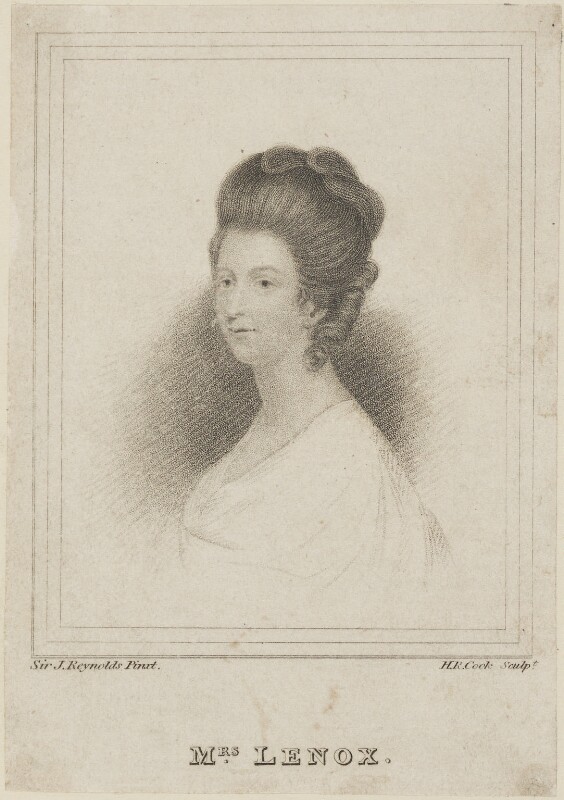
Charlotte Lennox (née Ramsay)
by Henry Richard Cook, after Sir Joshua Reynolds
stipple engraving, published circa 1793
NPG D14541
© National Portrait Gallery, London

The Charlotte Lennox Bibliography Project is planned to be an open-source born-digital descriptive bibliography that focuses on the work of Charlotte Lennox (1729-1804). Charlotte Lennox was one of the most famous women authors of her day; she wrote poetry, novels, plays, and essays, translated works on political science and history, classical theater, and published a periodical specifically aimed at women. Her proto-feminist leanings are clear with her focus on women’s education, intelligence, self-sufficiency, and potential. While there has been a rediscovery of her work and resurgence of interest in her novels, the scope of her creative efforts and breadth of contemporary interest in her publications, whether as author or translator, has remained largely invisible. This project seeks to remedy that and provide a source for future scholars of Lennox’s publications.

This blog serves as the public-facing starting point for this project, which will be an ongoing concern completed in stages. The first step, Stage 1, is determining the location of extant copies of her work published between 1747-1850, when interest in reprinting Lennox’s work decreased significantly. Stage 2 will focus on both examining copies and building an archive from the data gained, as well as determining the parameters for the online interface. Stage 3 will focus on the collation and interpretation of that data. The goal is to continually add to and update the bibliography over time so that usable information is available as soon as possible, even if the whole of the data is not yet complete.

The author of this project, Michelle Lyons-McFarland, is currently a full-time lecturer at Case Western Reserve University in Cleveland, OH, teaching professional and technical communication for engineers. She received her Ph.D. in 2018 from Case Western Reserve University, with research focuses in Eighteenth-Century Literature and Composition. In addition to teaching, Michelle is a tech editor for Digital Defoe, the online annual journal of The Defoe Society, and acted as a reviewer for the Year’s Work in English Studies from Oxford UP from 2019-2021.