Happy holidays, gentle readers! I hope this season finds you reasonably well, at least on a local level, given the general setting of GAAAAAH globally at the moment. I myself have been digging deep into work and family and friendship as a sustaining focus for the past two months, hence the lack of distinct November update.
I had the good(?) news that I’m teaching both an extra class in the spring and a class online in the summer (assuming it fills), which on the one hand, yay! My car approves this decision. On the other hand, prep and grading and whatnot have largely eaten my ability to focus on Lennox work, so I’ve decided to let this lie fallow for the holiday season while I work on clearing my plate for the coming year. In January, therefore, I’ll be picking back up with the project work as normal. I hope to have new progress to update next time around.
For now, however, I hope that whatever you celebrate, you are able to take a moment to yourself and acknowledge the dark and light, the turning of the year and the brightness inherent in the human spirit even when things seem hopeless. May we all have a brighter 2024.
Photo by u0410u043bu0435u043au0441u0430u043du0434u0430u0440 u0426u0432u0435u0442u0430u043du043eu0432u0438u045b on Pexels.com
Greetings, gentle readers! And a happy decorative gourd season to all who celebrate. As we reach midterms in the fall semester and all the grading that entails, I have taken a break to update you on this month’s progress.
The process of confirming or eliminating physical copies continues apace. Since the last update, I’ve worked through another 37 libraries*, completing the libraries that begin with the letter “B”. It will likely not be a surprise to anyone to know that there are quite a few libraries that begin with the letter B that have Lennox holdings, and that’s after some elimination of spurious, online access, or deaccessioned copies.
As for the database work, I’ve about decided that I’ll put in the libraries I’ve confirmed as locations for now, but not the individual titles. I may change my mind about that as I move forward, but we’ll see. I go back and forth on the utility of it prior to actually seeing and cataloging the data for a given copy.
In other news, I’m also trying to decide if I want to apply to any fellowships for next summer’s research. I’d been hoping to be further along than I am (though it’s not like every letter will have as many entries). It seems a shame to let a summer go to waste, but I’ve still got so much cataloguing to do. I have a little while more to ponder and see if the pace picks up in this portion of the endeavor.
Number of libraries confirmed: 77 Number of libraries entered into the database: 2 Number of extant copies confirmed: 299 (See Note)
* Note: Those observant readers among you will have noted that the letter “B” also applies to “Bodleian,” as in the famed library (or set thereof) at the University of Oxford. I cannot claim to have completed verification of my list of items at the Bodleian, given the nature of its search engine, the fact that defaults to including all the Oxford libraries, of which there are many, and the fact that it’s by no means uncommon to have multiple copies of the same work at different libraries within the greater institution of Oxford. I started working on it and quickly realized I was just going to need to pull out all the Oxford listings, put them in a big list with a couple of notepads and sticky notes as needed, and just do all of them in one big push. As I’m not planning to be in the UK any time in the near future, this isn’t really a problem per se, but it does mean that all Oxford listings are considered not fully confirmed until I clime that particular molehill.
Greetings, gentle readers! September finds me pushing forward still, albeit a bit more slowly due to general life issues and a lot of time dedicated to sorting through the works housed at the Beinecke Rare Book and Manuscript Library at Yale. Needless to say, we’re going to have to spend some time there in the future, to no one’s surprise.
I currently have 30 libraries verified, having removed two or three so far that ostensibly had only a couple of items at most, and they turned out to either simply not be there, to belong to an affiliated library on the same system, or to be online or microfom versions of the work. I am looking at applying to the Lewis Walpole Library Fellowship this year, along with perhaps a local fellowship that might cover some gas money for libraries near to hand.
Number of libraries confirmed: 34 Number of libraries entered into the database: 2 Number of extant copies confirmed: 148
Welcome to 2023! It’s been a busy holiday season — enough so that I didn’t manage to put up a post in December. The spring semester has started, though, and I’ve returned to my data entry. There are an absurd number of entries for the 1856 Bohn edition of The Memoirs of the Duke of Sully, but I’m pushing through. I’ve also had the chance to talk to the head of Special Collections at my institution’s library about increasing our Charlotte Lennox holdings. I’m very excited about the possibilities. Back to work, then!
This is a terribly short update, and terribly late as well. November was a very fallow month for the project, with nothing in particular getting done as the day job and the holidays have taken up all my bandwidth. I put off writing this because I was hopeful I would have a better update, but as it is now technically no longer November, I have accepted that this is as good as it gets. Hopefully Christmas break will be more productive again.
This month has seen a slowdown in work, in keeping with a rise of effort for the day job. Midterm grading is fast approaching, so I’m trying to stay caught up and yet still keep my hand in here. Also, it’s grant/fellowship application time for next year and I’ve got a job search to attend to, so we’re definitely keeping busy trying not only to keep this year’s ducks in a row, but obtain some ducks for next year as well.
That being said, things proceed apace. I’m at a total of 435 entries in the extant copy database, with two of the most populous and reprinted Lennox works yet to go. Preliminary data from my first special collections trip to Penn State has indicated a couple of interesting things, one of which is that Harrison & Co., publishers of Novelist’s Magazine in the late 1780s, may have simply taken extra copies of the novels reprints for their magazine (or vice versa), stripped off or reprinted the title pages, and bound them up either with other short works that met a given page/signature limit OR with the works that came after them in the magazine sequence, then sold them as standalone volumes. I have not yet been able to make a direct comparison between the bound volumes of the periodical and the novels, regrettably, but I think it’s entirely possible based on the similarities of paper, size, and typeface in their published works. I’m sure once I get past midterms, I’ll have more news. Until then, dear Reader.
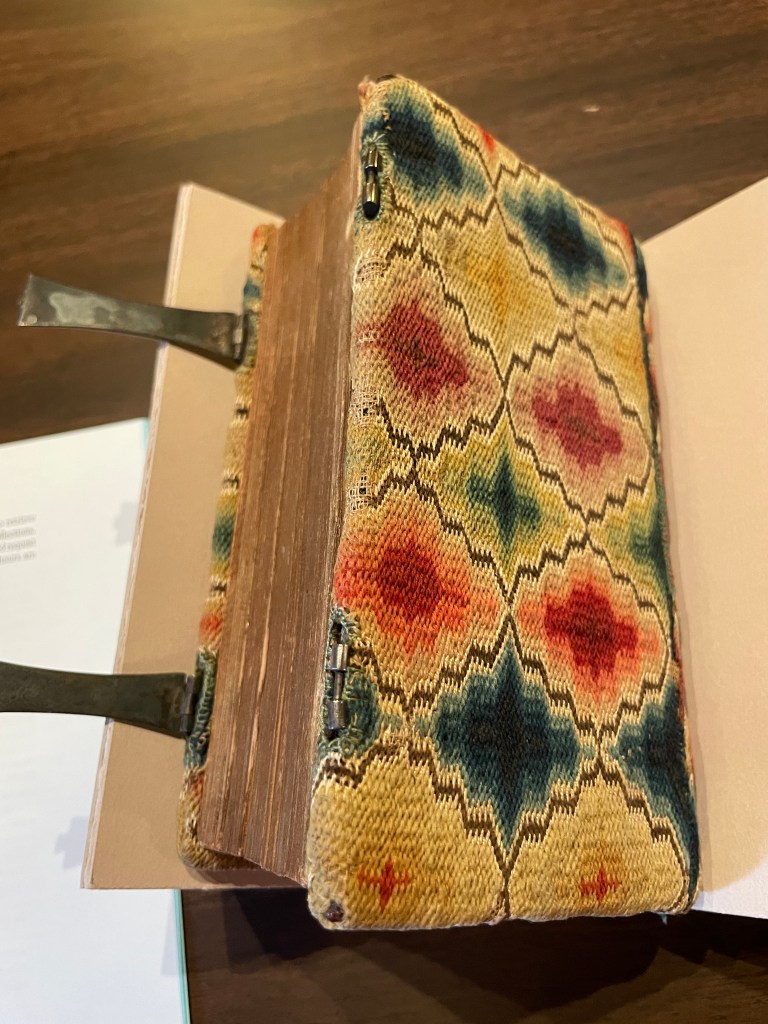
Oh, dear Readers, it has been an incredibly busy month. First of all, let me direct your attention to the picture on the right, which was only one of the amazing books I got to squee over and learn from at the RBS session on The History of the Book in America, 1700-1830, held at the Library Company of Philadelphia and taught by the excellent scholar James Green, who is Librarian Emeritus at that institution.
During that week, I learned very little about Lennox directly, but a ton about printing in the early United States and how her books likely came to be in the US. It opened so many avenues in my future research that I had not even considered, and I’m absolutely thrilled that I went. I should state that I was pleased to attend via a William T. Buice Scholarship, courtesy of UVa’s Rare Books School. I encourage anyone who’s interested, particularly NTT or independent scholars, to apply and help defray the tuition and fees involved with attending.
Aside from the RBS course, I’m incredibly excited to share that I’ve completed Phase 1.1 of the LBP! Phase 1.1 refers to the gathering of raw location data of extant copies of Lennox’s published work, recorded through Google maps and added to the Maps page on this site. The data now gets downloaded and converted to a .csv format, and then aggregated so I can check individual libraries for their actual holdings and eliminate any digital access copies that snuck in, or add material that got missed.
Once I’ve cleaned up and verified the data, then I’ll move on to analysis and remapping. At the same time, I’ll take on Phase 2, which is determining the data types I’m collecting and what I want the overall schema of the project to be. This section includes longevity planning, scalability, UI design and parameters, and a potential push for a sharable bibliographic interface that can be tweaked for use in other projects free of charge. I don’t anticipate starting Phase 2 before 2023, and I likely won’t be doing any serious data gathering on the books themselves until nearly 2024, though I’d be happy to be overestimating the timeline here.
All in all, I’m very excited about progress this summer and what next month brings. Stay tuned!
Mary Sandwith’s Bible, from 1743. She embroidered this cover as a girl — the date she stitched on the spine is from when she was 11 years old. Part of the Library Company of Philadelphia’s collections.
As I was browsing my way through the Penn State library website to determine what they had there that I’d need to use, I ran across an electronic copy of the work whose title page is featured here: Angelica; or Quixote in Petticoats, a Comedy in Two Acts. This 1758 play was not written by Charlotte Lennox, though there’s a note at the end of the dedication noting that they took Angelica (originally Arabella) and most of the plot wholesale from The Female Quixote by “Mrs. Lenox.” Nice to give credit for that much, at least, and it speaks to the contemporary popularity of the novel that it inspired this knock-off play.
Since the April update, the month has been extremely hectic. The end of the semester hit along with all the deadlines for grading and teaching, I caught a cold that turned into bronchitis (but was not covid), and my father passed away — all of which left the project lying somewhat fallow. That being said, I did get some additional progress made.
Current Status: In addition to the completed data from April, I have completed the information for Henrietta and Old City Manners, and begun working on Lennox’s play The Sister, which is based on her novel Henrietta and has led to a couple of confusing entries as a result. I’ve gotten them sorted, but it took slightly longer than I’d wanted. I’ve also added a Maps page with links to the Google maps I’ve created to plot out locations of extant copies of Lennox’s work. I’ve only got two works up so far (more evidence of my busy month) but I will have more this month. The information in those maps will be distilled out and converted into spreadsheets, but I’ve got more verification and data clean-up to do before that will be useful.
In addition, I’ll be attending a session of the University of Virginia’s Rare Book School in June, likely prior to the next update, focusing on the early history of printing in America to help me suss out what’s going on with Lennox’s early American reprints. I’ll be spending a week at the Library Company in Philadelphia and I cannot wait. It should be greatly enlightening, not to mention the fact that the Library Company has a number of hard-to-find works of Lennox’s and is on my list of locations to revisit at a later date.
Overall, I expect to make a nice bit of progress this month, so check back for more changes as we go.
This is the inaugural post for the Descriptive Bibliography of Charlotte Lennox. This project is still in its nascent stages, but to my mind that presents an opportunity seldom available: a chance to not only undertake a significant project (of a massive scope for one person, let’s be honest), but to create a public record of how and where and with what tools I’m trying to put it all together.
My goal is to eventually create an open-access, online, digitally born descriptive bibliography for the works of Charlotte Lennox. This blog will serve as the first markers on the virtual landscape, as it were, while I determine the scope, outline the plans, accumulate the materials, build the interface, and provide the interpretations of the eventual data. This project is a long time in the works even to this point, and it will be an even longer time until it’s completed. That being said, I believe it will be a worthwhile resource for scholars — not just because it provides an archive of Lennox’s life’s work and the materiality of those resulting publications, but because it stands to greatly expand out knowledge of what bibliography means in a world where scholarship is as much digital as analog.
In future posts, I plan to break down the stages of this project, the tools and methodologies I’m applying, the approach and rationale I’m using, and the early data I’ve accumulated (as well as the gaps therein), as well as a window into where things will go from here. I’m implementing a metadata tagging system within the blog so it’ll be easier to find relevant posts in the future by subject or reference. I’ll also be including images where useful, though it won’t be my primary focus.
In the end, I hope this blog (as well as the final project) will be useful to potential readers, if only as a record of how to climb the proverbial mountain one step at a time. I hope you’ll consider joining me on this journey. I can’t wait to see how it all turns out.